

HIV, Implementation
Quasi-experimental study of SKILLZ among younger adolescents in Zimbabwe
2006
Brief Summary
Background
There had been few evaluations of youth HIV prevention programs at the time of this study, particularly in Sub-Saharan Africa.
What Grassroot Soccer did
Grassroot Soccer evaluated the HIV/AIDS knowledge, attitudes, and behavioral intentions of participants before and after its foundational program, including the program's feasibility and cultural acceptability. The evaluation followed mixed gender adolescents ages 12-14 years old, professional soccer player Coaches, teachers and administrators, parents, and community members over 2 weeks (pre- to post-) and 5 months (pre- to follow-up).
What the study found
Participants showed significant increases in knowledge and attitudes on immediate post-intervention and 5-month follow-up surveys in the intervention group. Coaches, participants, teachers and health admin were satisfied with the program.
Why this matters
In its first ever evaluation, the original GRS curriculum was found to have positive effects on HIV knowledge, attitudes, and behavioral intention outcomes, and was highly acceptable among participants, Coaches, and school and health administrators.
DETAILED SUMMARY
Importance
- At the time of the study, few youth HIV prevention programs had been rigorously evaluated, and those that relied on teachers often faced challenges related to stigma, discomfort discussing sex, and limited interactivity.
Objective
- To assess if the GRS curriculum compared with standard school health education improves HIV/AIDS knowledge, attitudes, and behavioral intentions among 7th grade learners immediately after a two-week intervention and at five months follow-up.
- To explore if the GRS approach was feasible and culturally acceptable among schoolteachers and administration, parents, and community members.
Study details
- Study design: Quasi-experimental with mixed methods; included a control group (received standard HIV education already offered in school)
- Data collection tools: Pre-, post-, and follow-up questionnaires (5 months later); formative research for intervention development; 5 focus group discussions with Coaches (i.e., soccer players) and teachers
- Participants: Mixed gender adolescents ages 12-14 years old, professional soccer player Coaches, teachers and administrators, parents, and community members
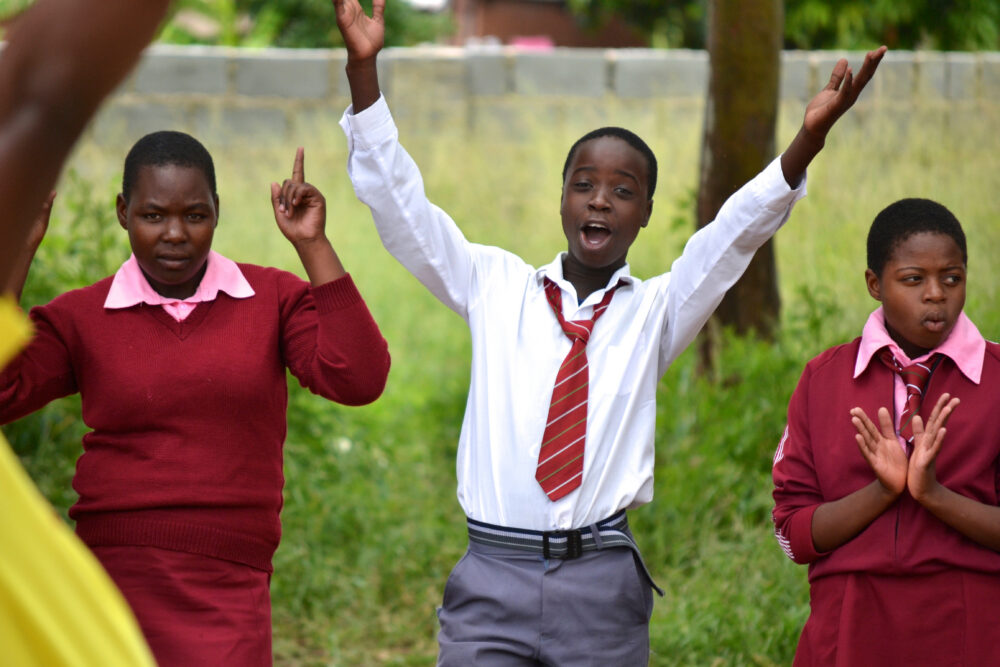
- Implementation setting: 7th grade classes at 4 primary schools in Bulawayo, Zimbabwe (urban)
- Study period: 2 weeks (pre- to post-) and 5 months (pre- to follow-up)
Intervention
- First iteration of “Grassroot Soccer” (similar to SKILLZ Core): Four 2-hour sessions delivered over two weeks; 4 Coaches present at each session; delivered in groups of 40 students.
Results
- Pre- and immediate post-intervention survey completed by 304 learners (155 intervention, 149 control); 5-month follow-up was completed by only about 51% (79 intervention, 77 control)
- Significant increases in knowledge and attitudes on immediate post-intervention and 5-month follow-up surveys in the intervention group. Percentages at post:
- Beliefs that condoms are effective at preventing HIV: 53% pre, 78% post (p<0.01)
- Could list 3 people they could talk to about HIV: 48% pre, 64% post (p<0.01)
- Would not avoid a classmate who is HIV-positive: 49% pre, 60% post (p=0.068)
- Knew where to look for help for HIV-related problems: 51% pre, 78% post (p<0.01)
- Little or no change in these responses in the control group
- Delayed increase in these outcomes observed among control group at 5-months, suggesting possible diffusion of information from peers in the intervention group
- Coaches felt comfortable with curriculum and found the program meaningful; participants reported remembering what they learned and large majority liked the program; teachers and health admin were very satisfied with the program
Conclusions and implications
- The original GRS curriculum was found to have positive effects on HIV knowledge, attitudes, and behavioral intention outcomes, and was highly acceptable among participants, Coaches, and school and health administrators.
- The “catch-up” effects in the control group led to further investigation in a diffusion study
Citation
Year: 2006
Authors: Clark TS, Friedrich GK, Ndlovu M, Neilands TB, McFarland W
Clark TS, Friedrich GK, Ndlovu M, Neilands TB, McFarland W. An adolescent-targeted HIV prevention project using African professional soccer players as role models and educators in Bulawayo, Zimbabwe. AIDS Behav. 2006;10(Suppl 1):77-83. DOI: 10.1007/s10461-006-9140-4.
Partners
University of California
San Francisco (Center for AIDS Prevention Studies)
San Francisco Department of Public Health
Funder
Bill and Melinda Gates Foundation
Other Resources
Cross-sectional study of Digital MindSKILLZ among mobile phone users in six sub-Saharan African countries
Youth Participatory Action Research for SKILLZ Girl among adolescent girls in South Africa