

Gender & violence, Health services, HIV, Resilience
Mixed methods study of SKILLZ for HIV prevention among adolescents in Ethiopia
2016
Brief Summary
Background
Ethiopia experienced a large increase in HIV prevalence in the 1990s which resulted in a need for youth-based HIV prevention initiatives.
What Grassroot Soccer did
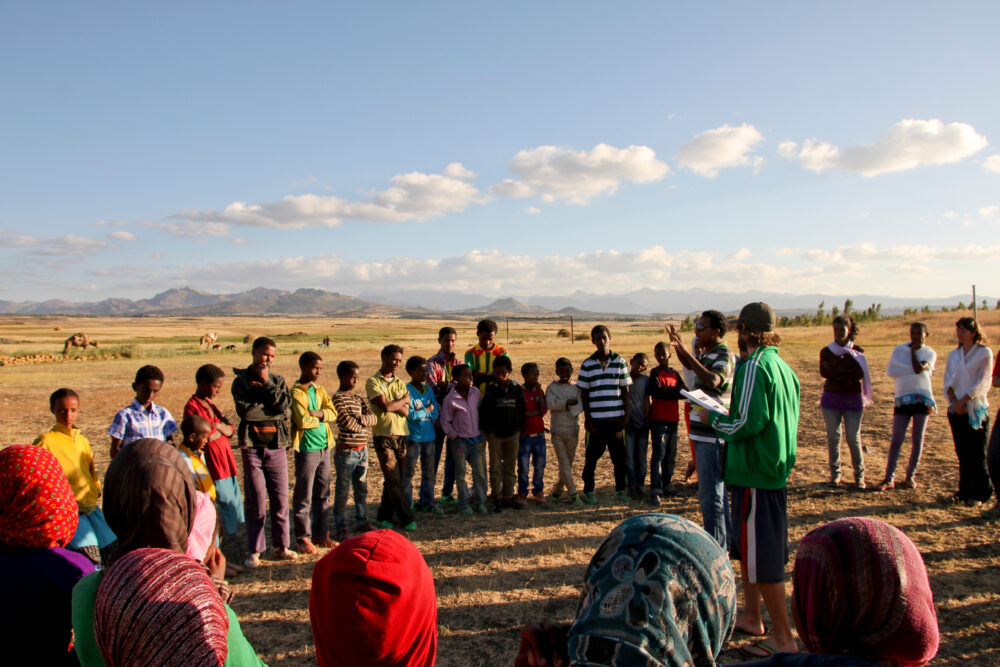
Grassroot Soccer implemented Sport For Life, a sport-based HIV prevention 4 month long program, that was delivered in Ethiopian primary and secondary schools to mixed gender adolescents, assessing health outcome change and national adoption over a 10 year period.
What the study found
Participants showed an improvement in HIV-related knowledge and increased communication. Qualitative data from staff showed that national adoption relied on partnerships, political alignment and oversight.
Why this matters
Sport For Life could be an effective model for youth-targeted behavior change programming and may also have potential to be implemented at the national level due to its high acceptability.
DETAILED SUMMARY
Importance
- Ethiopia experienced a rapid rise in HIV prevalence during the 1990s, prompting national prioritization of youth-focused HIV prevention. Sport-based HIV prevention approaches have demonstrated promise, so GRS aimed to explore the reach of Sport For Life and pathways for its national adoption.
Objective
- To evaluate whether Sport For Life improves HIV-related knowledge, communication, and attitudes among adolescents and to examine pathways to national adoption over a four-month intervention period in Ethiopian schools.
Study details
- Study design: Mixed methods study; no control group.
- Data collection tools: Attendance registers; pre- and post-questionnaires; focus group discussions (3 groups with SFL participants, teachers, and trainers); key informant interviews (3 interviews with partner organization staff).
- Participants: Mixed-gender adolescents with a median age of 15 years, SFL-trained teachers, SFL trainers, and partner organization staff.
- Implementation setting: Primary and secondary schools in Addis Ababa, Ethiopia (predominantly urban and peri-urban).
- Study period: Attendance data collected 2004–2014; pre- and post-questionnaires administered immediately before and after a four-month program.
Intervention
- Other – Sport For Life: A sport-based HIV prevention curriculum delivered through structured football activities and facilitated discussions.
Results
- Reach: Attendance data show approximately 701,705 Ethiopian students participated in Sport For Life between 2004 and 2014.
- Quantitative findings: Results demonstrate an overall increase in favorable responses from pre- to post-questionnaire among Ethiopian participants (rate ratio: 1.12). The largest improvement was observed in knowledge of khat as an HIV risk factor (rate ratio: 2.17). Results demonstrate increased communication about HIV with adults (rate ratio: 2.07) and friends (rate ratio: 1.81).
- Comparative findings: Pre/post changes among Ethiopian participants were comparable to those observed at Grassroot Soccer–managed sites in South Africa, with greater improvements in HIV-related communication and stigma reduction observed in Ethiopia.
- Quote:
- “We learn on SFL with games and physical activities and we will not get bored and forget the points.” (SFL participant)
Conclusions and implications
- Results demonstrate that Sport For Life improves HIV-related knowledge, communication, and attitudes among adolescents.
- Focus group discussions and interviews suggest that strategic partnerships, political alignment, and sustained training and monitoring were critical to national adoption.
Citation
Year: 2016
Authors: Friedrich K, Hershow RB, Merrill J, Gannett K, Tsegaye E, Kebede D, DeCelles J
Friedrich K, Hershow RB, Merrill J, Gannett K, Tsegaye E, Kebede D, DeCelles J. The road to national adoption: a mixed-methods study of Grassroot Soccer's Sport For Life partnership program in Ethiopia [poster]. Presented at: Social and Behaviour Change Communication Summit (SBCC 2016); 2016 Jan 29; Addis Ababa, Ethiopia.
Partners
University of North Carolina Gillings School of Global Public Health
London School of Hygiene & Tropical Medicine
Partners for Health
Funder
USAID (via Health Communication Partnership)
Other Resources
Cross-sectional study of Digital MindSKILLZ among mobile phone users in six sub-Saharan African countries
Cluster randomized controlled trial of SKILLZ Girl among adolescent girls in Zambia: Effects on sexual and reproductive empowerment