

Gender & violence, Health services, HIV, Resilience, Sexual & reproductive health
Randomized controlled trial of SKILLZ Core among adolescents in Tanzania
2020
Brief Summary
Background
Adolescent girls in Tanzania and across sub-Saharan Africa face high rates of unintended pregnancy, HIV, and intimate partner violence, but most programs focus only on girls and rarely test which specific components actually drive change.
What Grassroot Soccer did
Grassroot Soccer, alongside partner organizations, tested three approaches within community youth clubs in Tanzania: soccer-based health education for adolescent boys, a goal-setting activity for adolescent girls, and access to free contraceptives, reaching about 4,500 adolescents over several years
What the study found
Both the boys' soccer-based education and the girls' goal-setting activity were linked to reductions in intimate partner violence and more equitable attitudes about gender and violence. Providing contraceptives alone, without accompanying education, did not lead to measurable improvements in reproductive health outcomes.
Why this matters
Findings suggest that engaging young men alongside young women, and pairing service access with education and skill-building, may be a more effective and affordable way to reduce violence and support healthier relationships among adolescents.
DETAILED SUMMARY
Importance
- Adolescent girls in sub-Saharan Africa – and Tanzania specifically – face high rates of unintended pregnancy, HIV infection, and intimate partner violence (IPV). Traditional SRH programs often target older or married women, neglecting adolescent boys and failing to disentangle which program components drive impact.
Objective
- To evaluate whether soccer-based education for adolescent boys, goal-setting exercises for adolescent girls, and contraceptive supply through Empowerment and Livelihood for Adolescents (ELA) clubs improve sexual and reproductive health outcomes (unintended pregnancy, HIV/STI, IPV) among adolescents aged 11–24 years in community ELA clubs across Tanzania over 2 years.
Study details
- Study design: Randomized controlled trial.
- Data collection tools: Baseline and endline surveys, biomedical HIV/STI testing, attendance tracking, and six-month goal-setting follow-up.
- Participants: About 4,500 adolescents, aged 11–24 years; mixed gender.
- Implementation setting: 150 BRAC ELA clubs in Dodoma, Iringa, and Mbeya regions, Tanzania (rural and peri-urban).
- Study period: 2016–2020.
Intervention
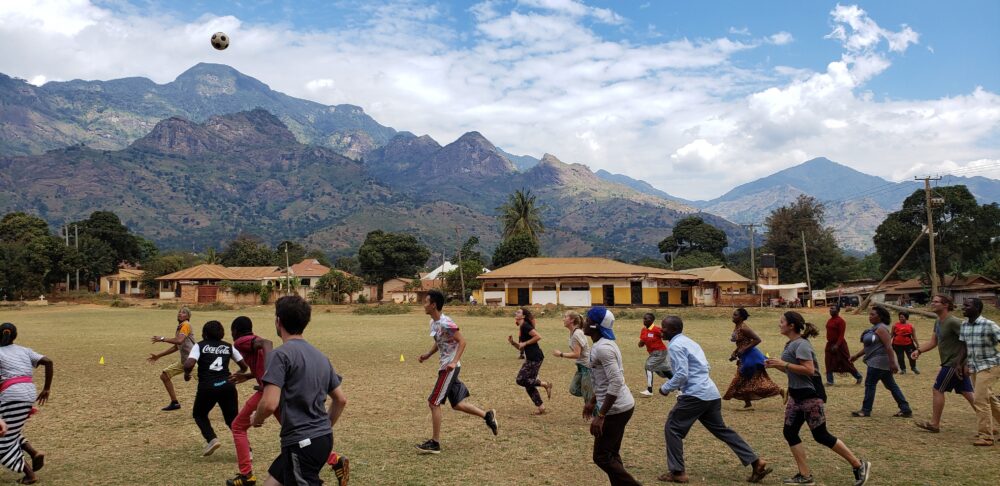
- SKILLZ Core: Boys participated in ten mandatory 90-minute soccer-based sessions delivered over a 10-week period by trained GRS coaches. Sessions were delivered in community and school settings, with additional optional one-on-one coach support following practices.
Results
- Benefits: Soccer-based health education for boys significantly reduced female reports of IPV (occurring “often” in the past year) by 0.16 standard deviations, goal-setting among girls reduced IPV by 0.13 standard deviations, and boys showed more egalitarian gender attitudes and lower acceptance of violence.
- HIV/STI and Pregnancy: No statistically significant effects on HIV/STI or unintended pregnancy.
Conclusions and implications
- Engaging males via sport-based SRH education and empowering females through structured goal-setting can both reduce IPV and shift gender norms. Supplying contraceptives alone without accompanying behavioral or attitudinal interventions did not improve SRH outcomes.
- Combining GRS-style programs for boys with goal-setting interventions for girls offers scalable, low-cost strategies to prevent IPV and promote gender-equitable norms.
- Future programming should integrate male engagement, female empowerment, and sustained access to contraceptive services for broader SRH impact.
Citation
Year: 2021
Authors: Shah M, Seager J
Shah M, Seager J. Goal-setting and including males: improving sexual and reproductive health for female adolescents and young women [Internet]. Los Angeles (CA): UCLA Luskin Global Lab for Research in Action; [cited 2026 Jul 31]. Available from: https://global-lab.luskin.ucla.edu.
Partners
Grassroot Soccer Partnerships Team (training and implementation partner with IDYDC)
University of California Los Angeles Global Lab for Research in Action
BRAC Tanzania
Marie Stopes Tanzania
Funder
William and Flora Hewlett Foundation
Gender Innovation Lab, World Bank
Other Resources
Cross-sectional study of Digital MindSKILLZ among mobile phone users in six sub-Saharan African countries
Cluster randomized controlled trial of SKILLZ Girl among adolescent girls in Zambia: Effects on sexual and reproductive empowerment