Educational attainment, Gender & violence, Health communication, Health services, Self-efficacy & resilience, Sexual & reproductive health

Mixed methods study of SKILLZ afterschool soccer and life skills program among adolescent girls in South Africa

2016

Brief Summary

Background

Adolescent girls in South Africa face significant barriers to physical activity, particularly in urban communities where soccer is seen as a male sport. These inequalities limit girls' opportunities for health, development, and empowerment.

What Grassroot Soccer did

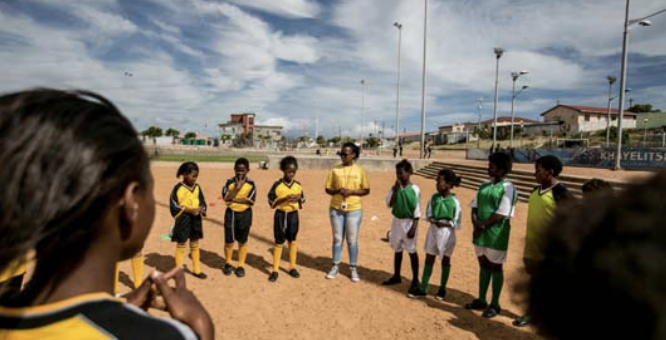
Grassroot Soccer implemented SKILLZ Banyana, an afterschool soccer and life skills program run by female coaches across five schools in Khayelitsha, Cape Town, serving girls aged 9–14 years.

What the study found

While demand for the program was strong, girls faced barriers including limited resources, lack of community support, and gender stereotypes that stigmatized girls' participation in soccer.

Why this matters

These findings highlight the importance of engaging parents, teachers, and community members alongside young people to challenge harmful gender norms and build lasting support for girls' participation in sport.

DETAILED SUMMARY

Importance

  • Adolescent females are less likely to be involved in physical activities in comparison to males, particularly in urban settings as they move from childhood into adolescence. Low levels of physical activity are linked to the spread of non-communicable disease. Soccer in South Africa is viewed as masculine, which leads to gender imbalances and disempowerment of women.

Objective

  • To use an afterschool program to allow young girls to develop soccer skills and life skills while improving physical health, academic performance, and self-esteem.

Study details

  • Study design: Mixed methods study (no control group)
  • Data collection: 4 interviews with teachers from four of five implementing schools; 1 interview with the Project Coordinator; 4 focus group discussions with participants (n=14) and Coaches (n=10)
  • Participants: Girls aged 9-14 years
  • Implementation setting: Khayelitsha township in Cape Town, South Africa
  • Study period: November 2015 to February 2016

Intervention

  • SKILLZ Banyana: An afterschool soccer-based life skills program and league run by female mentors (SKILLZ Coaches) over the course of two school terms with the intent to improve physical health, academic performance, and self-esteem as Coaches relate program activities to broader issues of gender and rights.

Results

  • Preliminary results revealed challenges and opportunities faced by young adolescent girls who enrolled in SKILLZ Banyana:
    • Barriers to access: Teachers indicate that there are no barriers to girls doing anything boys can do, but there are few resources invested in girls’ soccer, limited support from the community, and a lack of necessary infrastructure that would facilitate girls’ access to soccer.
    • Policing sexuality: The idea that playing a sport “for males” might impact how girls think of their sexuality is a significant barrier for girls who want to play soccer.
    • Quote: “They will change [girls into tomboys] if they play soccer. You can’t run from that. That’s the way I see it.” (Teacher, Khayelitsha)

Conclusions and Implications

  • For the SKILLZ Banyana program to be successful, other community members (parents, teachers, peer learners) must be included so that harmful gender norms and stereotypes are challenged on multiple levels. It is clear that demand for organized team sports among pre- and early adolescent girls exists.
  • Grassroot Soccer is engaging Local Football Associations, Khayelitsha schools, and community leaders with a view to creating a sustainable all-girls soccer league based on SKILLZ Banyana.

Citation

Banciu RL, Barkley CK, Sanders BF. Gender norms, sexuality and sport for development: challenges faced by adolescent girls when participating in a soccer-based life skills programme in Khayelitsha, South Africa [poster]. Presented at: International AIDS Conference (IAC); 2016; Durban, South Africa.

Other Resources