

Gender & violence, Health services, HIV, Resilience, Sexual & reproductive health

Cross-Sectional Study of SKILLZ Street Plus Among Adolescent Girls in South Africa

2015

Brief Summary

Background

Adolescent girls in South Africa face high rates of sexual violence and HIV, with girls aged 15-19 years being eight times more likely to have HIV than boys the same age. Understanding girls' experiences and beliefs before an intervention is critical to designing effective programs.

What Grassroot Soccer did

Grassroot Soccer surveyed 200 grade 8 girls in Soweto to understand their knowledge, attitudes, and experiences related to gender, relationships, and violence, gathering baseline data to inform the SKILLZ Street Plus program.

What the study found

Many girls reported experiencing violence, and acceptance of intimate partner violence increased with age. Older girls also showed lower gender-equitable beliefs and HIV knowledge than younger girls.

Why this matters

These findings highlight the urgent need for early, girl-centered interventions and underscore the importance of linking sport-based programs to broader support systems for adolescent girls.

DETAILED SUMMARY

Importance

  • South Africa has one of the highest rates of sexual violence against girls 12-17 years, and as a result, adolescent girls 15-19 years are eight times as likely to have HIV as boys the same age.

Objective

  • To understand the practices, attitudes, knowledge, and experiences of adolescent girls (11-16 years) in Soweto, South Africa, related to gender, intimate relationships, and violence prior at baseline of a two-year longitudinal study.

Study details

  • Study design: Cross-sectional study (baseline survey)
  • Data collection tools: Baseline surveys only (mobile phones using Open Data Kit software)
  • Participants: Grade 8 female learners (n = 200; mean age = 13.61 years)
  • Implementation setting: 4 schools in Soweto, Gauteng, South Africa
  • Study period: May 2014

Intervention

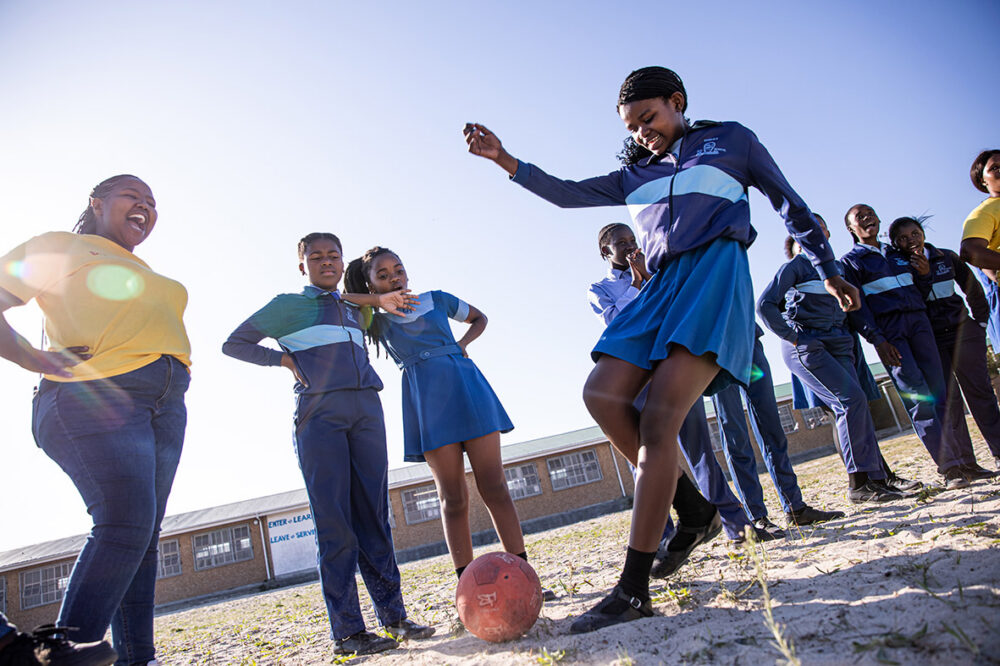
  • Designed to inform SKILLZ Street Plus (SSP): 14-session, 28-hour intervention using a network of female coaches to deliver the curriculum, mentor the girls, and facilitate soccer-based life activities.

Results

  • Gender beliefs & self-efficacy: Younger adolescents (11–13 years) reported higher gender-equitable beliefs (21%) and self-efficacy (25–32%) than older adolescents (7% and 15%, respectively, among 15–16-year-olds).
  • Violence attitudes: 31% reported that IPV was unacceptable; justification of a boyfriend’s violence increased with age (18% among 11-13 year-olds; 33% among 15-16 year-olds).
  • HIV knowledge: Mean HIV-related knowledge decreased with age (3.53 among 11–13-year-olds vs. 3.22 among 15–16-year-olds).
  • Soccer benefits: Higher perceived benefits of soccer were associated with higher self-efficacy and more gender-equitable beliefs.
  • Violence exposure: In the past 12 months, 42% reported experiencing IPV and 63% reported non-partner violence. Streets were most commonly identified as high-risk locations for violence (47%), followed by schools (24%) and homes (17%).
  • Disclosure & reporting: Among those experiencing violence, 62% disclosed to parents (primarily mothers, 58%); reporting to police was less common (31% for IPV; 36% for non-partner violence).

Conclusions and Implications

  • There is a need to understand which social, relational, and psychological factors influence experiences and perceptions of violence among adolescent girls at different ages or developmental stages. Creating a safe space and integrating linkages to support services, family, and schools is critical.
  • This baseline study will be used as a comparison for an endline survey following SSP to determine whether the use of sport-based methodology can positively impact participants’ knowledge and attitudes towards violence and reduce the likelihood of experiencing violence.

Citation

Year: 2015

Authors: Hershow RB, Sanders BF, Barkley CK, Rakosa B, DeCelles J, Das M

Hershow RB, Sanders BF, Barkley CK, Rakosa B, DeCelles J, Das M. Knowledge, attitudes, and experiences of violence among adolescent girls: a baseline assessment in the Soweto township of South Africa. Presented as a poster at: 8th IAS Conference on HIV Pathogenesis, Treatment and Prevention (IAS 2015); 2015 Jul 19-22; Vancouver, Canada.

Other Resources