


Closing the Adolescent Mental Health Gap: New Evidence for MindSKILLZ
July 20, 2026
In sub-Saharan Africa, where the prevalence of adolescent mental health challenges is estimated to be higher than other global regions, as few as one in 10 people with a mental health condition ever receive care. On top of that, there is almost no universally delivered, lay-provider mental health promotion for adolescents.
This care gap is one of the largest and most critical in global health. To fill it, Grassroot Soccer is training non-specialists (Coaches) to strengthen young people’s mental health awareness, knowledge, coping skills, and resilience, as well as reduce stigma and harmful misconceptions about mental health that create significant barriers for young people who need support or care.
In 10 countries, trained Grassroot Soccer Coaches have worked with young people through MindSKILLZ: Grassroot Soccer’s signature 10-session mental health program, which employs a positive, strengths-based approach that uses soccer metaphors and activities to engage young people and help them build a lasting foundation for positive mental health into adulthood. More than 110,000 adolescents have now gone through the MindSKILLZ program, and more than 1.4 million people across seven countries have played the phone-based Digital MindSKILLZ game.
Now, two new papers published in peer-reviewed journals – the first in Frontiers in Public Health and the second in the Journal of Sport for Development – establish a robust, externally validated evidence base for the MindSKILLZ model, showing that the program delivers clinically significant improvements in young people’s mental health and well-being.
This is a critical milestone. As Grassroot Soccer works to sustainably scale MindSKILLZ through government systems across sub-Saharan Africa in the coming years, peer-reviewed evidence is what makes that scale-up credible to the ministries, funders, and partners who will carry it forward – and helps fill larger evidence gaps in the field of youth mental health in low- and middle-income countries (LMIC).
A Mixed-Methods Pilot Study in Kenya
In Kenya, Grassroot Soccer and local partner LVCT Health conducted a mixed-methods study of the first MindSKILLZ implementation in Kenya to collect initial data on the program’s effectiveness and acceptability.
The study included pre- and post-intervention surveys of more than 250 program participants; focus group discussions; and interviews with participants, Coaches, and key stakeholders, including from the Mombasa and Nairobi County Departments of Health.
Results published in Frontiers in Public Health show positive trends across all quantitative measures: mental well-being, depression symptoms, mental health stigma, support seeking, emotional symptoms, and conduct problems all improved following the program. Participants and Coaches alike also described enhanced coping skills and improved stress and anger management from MindSKILLZ.
“In MindSKILLZ, I learnt how to breathe in, and breathe out…. to get rid of anger.” (MindSKILLZ Participant, Kenya)
Importantly, an overwhelming majority of adolescents (91%) reported that they liked MindSKILLZ and attending the sessions “a lot” – deeming the program and its fun, play-based methodology highly acceptable – and key stakeholders highlighted its potential for sustainability and scale.
Insights from Routine Monitoring Data Across Three Countries
Analyses of routine program monitoring data from nearly 2,300 MindSKILLZ participants in Kenya, Zambia, and Zimbabwe show that MindSKILLZ is delivering measurable mental health gains for adolescents at scale.
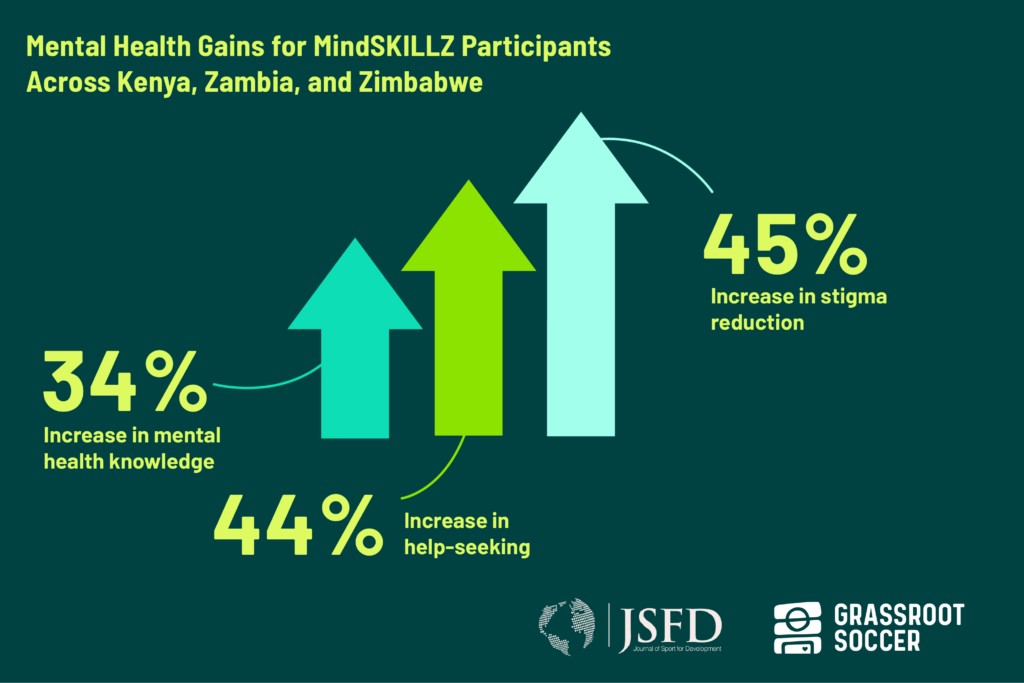
Findings published in the Journal of Sport for Development show that across these three countries, MindSKILLZ participants’ mental health stigma decreased while help-seeking and mental health knowledge increased, leading to clinically significant improvements in young people’s mental health and well-being.
Well-being gains among participants exceeded the clinical significance threshold (>10) on the WHO-5 index, with an aggregate increase of 11.4 points. Analyses also showed statistically significant improvements on every construct measured, including moderate-to-large effects on several key factors that help young people maintain their mental well-being:
- mental health stigma fell roughly 45%
- willingness to seek help rose roughly 44%
- mental health knowledge rose roughly 34%
Turning Evidence to Impact
Since three-quarters of adult mental health conditions surface by age 24, adolescence is a key window of opportunity to promote good mental health and treat disease before conditions progress into adulthood and lead to more severe consequences.
Through MindSKILLZ, Grassroot Soccer is ensuring that adolescents can build the critical mental health knowledge, coping skills, and resiliency during this critical moment of their lives.
Findings from these two peer-reviewed publications suggest that MindSKILLZ – a low-cost, non-clinical program that leverages the power of soccer and play to engage adolescents – can address one of the widest and most critical care gaps in global health as the scalable primary prevention that governments and funders need but rarely have evidence for.
As the two studies show, MindSKILLZ is producing clinically relevant improvements in adolescent well-being and the protective factors that support long-term positive mental health – making a meaningful positive difference in adolescents’ lived experience, including how they function and feel in their daily lives.
For more information, contact Grassroot Soccer Senior Technical Advisor, Mental Health, Chris Barkley at [email protected].